
By Hytanbio Tech | Updated
Short answer. Human factors evaluation asks whether intended users can operate the proposed injection pen safely in its intended setting. It requires a defined user interface, representative users and a risk-based view of tasks. A successful internal demonstration or an attractive prototype does not establish usability for the intended population.
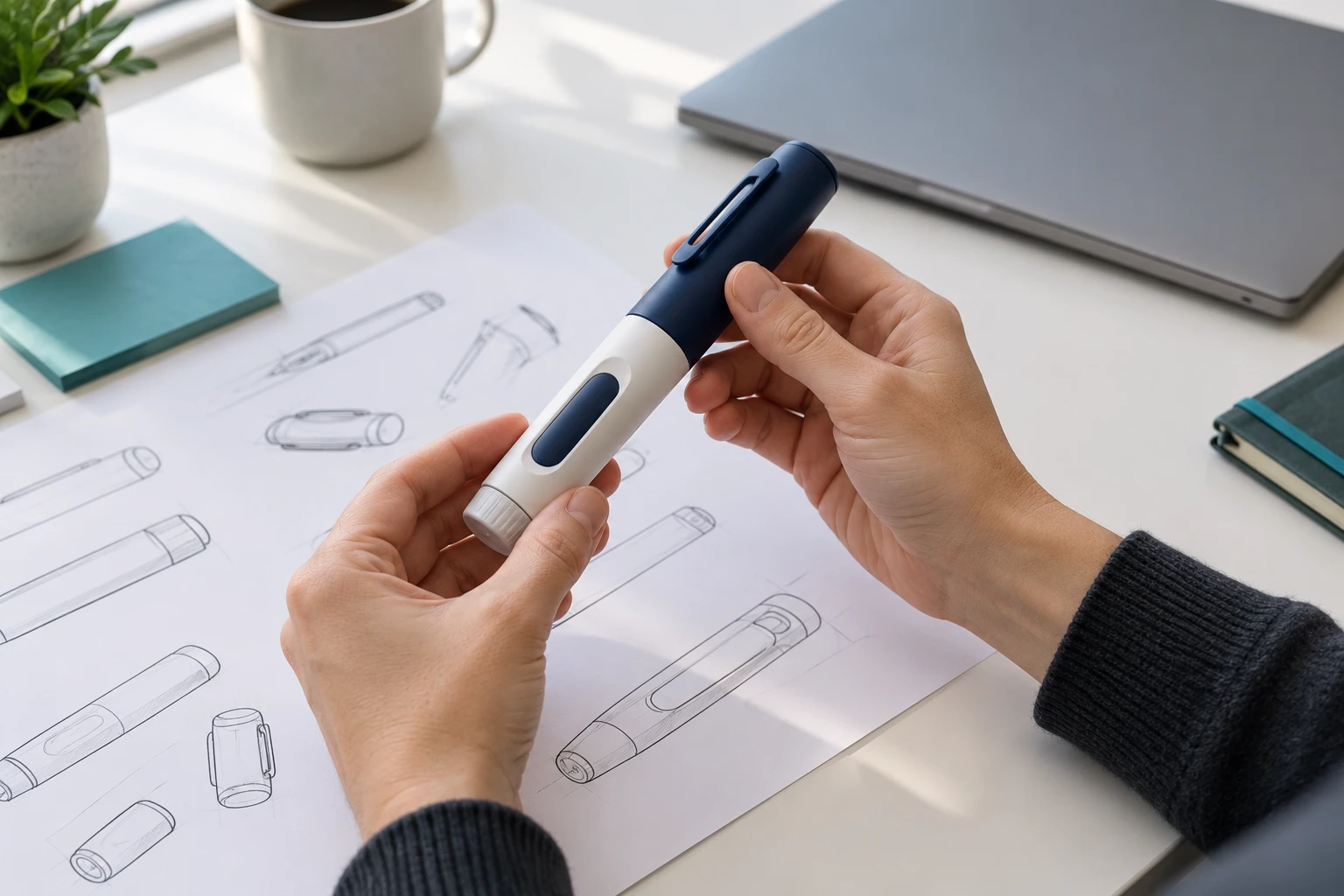
Define the users and the interface before counting participants
FDA describes device users, use environments and user interfaces as central elements of human factors evaluation. An injection pen project should therefore identify who will interact with the device and which limitations or experience levels are relevant before planning an assessment. A trained development engineer may recognize feedback that a new user does not notice. Home use can introduce different conditions from a supervised demonstration. The interface includes more than the physical selector: packaging identification, readable state indications and the instructions provided with the proposed product also affect interaction. Translate those observations into project questions rather than assuming that a familiar pen shape is intuitive. Record the intended population and setting in the development brief, and explain how each proposed evaluation relates to that brief. This makes a usability quotation comparable across suppliers and research partners.
Reference: FDA: Applying Human Factors and Usability Engineering to Medical Devices (final guidance).
Treat participant numbers as part of a justified study plan
FDA's human factors guidance discusses a minimum of 15 participants for each distinct user population in validation testing. This is a source-specific recommendation, not a universal statement that 15 people in total will establish every injection pen's usability. Distinct populations may have different tasks, knowledge or interaction risks. The responsible study team must justify which groups are represented and the evaluation approach for the intended device. A procurement brief should request that rationale instead of purchasing a study by headcount alone. Keep formative design learning separate from the validation question addressed by the final proposed interface. Ask which interface revision, instructions and representative conditions the resulting record will describe. A numerical recruitment target cannot repair an undefined intended-use statement, an unexplained population choice or a device configuration that changes after the evaluation.
Connect use-related observations to design decisions
For an injector pen, the project team may need to examine whether users identify the correct device, recognize its state and understand the feedback provided by the intended interface. These are examples of review questions, not a complete list of critical tasks for every product. The use-related risk analysis should determine which tasks could lead to harm and which observations require investigation. A report should explain relevant difficulties, their causes and the resulting design or risk decisions. A record containing only a satisfaction score cannot provide that traceability. Changes to labeling, feedback or the operating sequence should be assessed against the evidence already collected. During OEM development, clarify who owns the user-interface specification and who approves later changes. Human factors documentation supports the finished-product development record; it does not provide clinical instructions or authorize a generic pen for a named medicine.
Procurement review checklist
- Intended users and use environments defined before recruitment
- Relevant user groups and study rationale documented
- Interface, labeling and instructions linked to a controlled revision
- Use-related observations connected to risk and design decisions
Frequently Asked Questions
Does testing with 15 people always satisfy human factors validation?
No. The FDA recommendation is framed around distinct user populations and an appropriate evaluation. Population choice, intended conditions, interface configuration and the study rationale still require justification.
Can factory employees replace representative intended users?
Their design knowledge and experience may differ from the intended population. The study team must justify representative recruitment rather than assuming an internal demonstration establishes usability.
Sources and editorial scope
- FDA: Applying Human Factors and Usability Engineering to Medical Devices (final guidance)
- FDA: Human Factors Considerations
- FDA human factors guidance: distinct populations and participant recommendation
References checked October 23, 2026. This article provides procurement and engineering review considerations. It does not report Hytanbio test results, reproduce proprietary standard requirements, certify a device or replace product-specific regulatory and clinical advice.