
By Hytanbio Tech | Updated
An injection pen force specification needs a defined measurement point, speed, device configuration and fluid condition. Injection time needs its own start and stop events. For insulin or peptide injector pen development, compare the assembled delivery system under the intended conditions; an empty mechanism test cannot establish filled-product performance.
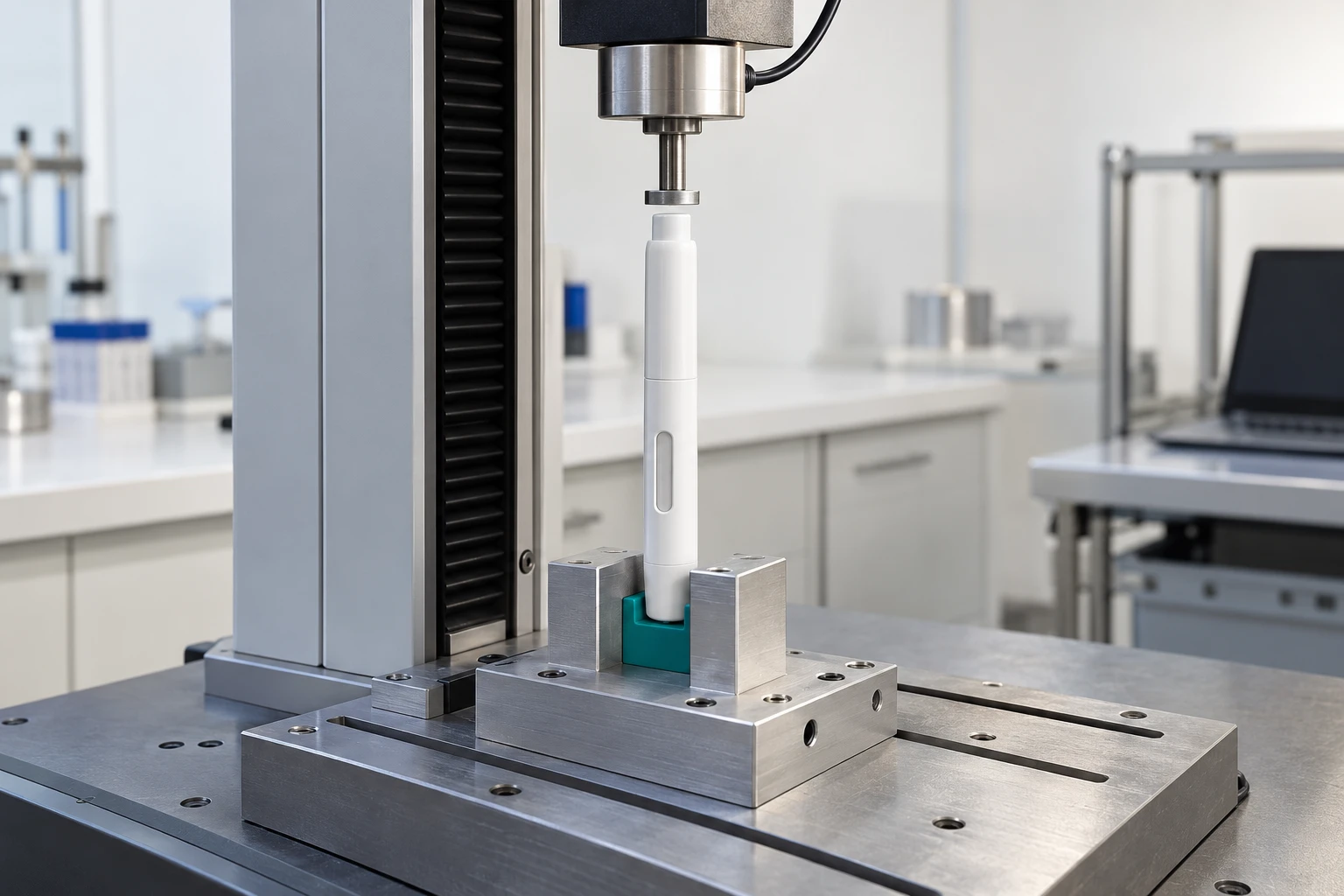
Identify the function and the measurement point
Name the function before asking a supplier for a force value. Cap removal, dose setting, activation and delivery are separate operations, with different measurement locations. A manual pen transfers force from the user's thumb through its mechanism; an autoinjector adds a drive system whose output changes during the delivery stroke. Record whether the quoted value is measured at the user interface or at a component. FDA's October 2026 performance draft illustrates this distinction: it treats injection time as a potential system-level characteristic for an autoinjector, while syringe break-loose and glide forces can be component-level contributors. The document remains a draft for comment, not guidance for implementation. Use its examples to frame questions, then have the responsible development team identify the characteristics applicable to the actual product. A supplier's single force number needs these definitions before it can be compared with another quotation.
Separate the requested measurements
- Cap removal force: measurement direction and grip arrangement
- Activation force: button or shield interface and actuation speed
- Injection force: defined manual delivery operation and test speed
- Break-loose and glide force: identified container, stopper and conditions
- Injection time: agreed start event, completion event and observation method
Source references: FDA: Essential Drug Delivery Performance Characteristics, October 2026 draft guidance, FDA: October 2026 draft guidance, sections IV-V and appendices B-C.
Build the matrix around formulation and fluid-path conditions
Ask the formulation owner for the conditions the device has to accommodate. Viscosity should be tied to temperature and an identified measurement method, especially when a surrogate liquid is proposed. Needle geometry and container friction also belong in the configuration record. A manufacturer-published example makes the scope visible: Ypsomed and BD evaluated four needle configurations across up to five viscosity levels, from 11 to 70 cP, in a 2.25 mL syringe-autoinjector platform study. Those are study conditions, not a capability claim for Hytanbio or a specification for another medicine. The procurement lesson is to request a matrix rather than an isolated nominal result. Ask which combinations were evaluated, which were omitted and how the fluid represents the intended formulation. Keep the original conditions beside every reported result so a convenient surrogate does not silently become the basis for a commercial-product claim.
Fields to put in the development brief
- Device and container references, drawing revisions and fill volume in mL
- Liquid identity, viscosity in cP or mPa s, temperature and measurement method
- Needle reference, effective length and documented flow-path geometry
- Sample conditioning, orientation and relevant age or use history
- Rationale for any surrogate formulation and the remaining evidence gap
Source references: Ypsomed and BD: Optimizing high-dose delivery, May 28, 2025.
Read the force trace alongside the delivered-volume result
A force trace describes how resistance changes during an operation. Its peak, running region and end-of-stroke behavior can answer different engineering questions, so ask for the underlying trace and the method used to reduce it to reported values. A summary value without the fixture arrangement or sampling details is difficult to interpret. For delivery time, define whether timing starts at activation, the beginning of plunger movement or another observable event. The stopping event also needs a definition that matches the proposed function. Neither a smooth trace nor a short delivery time establishes that the intended volume was delivered. Request the corresponding volume assessment and any explanation of incomplete strokes, leakage or unusual observations. The developer should decide which measurements must come from the same specimens and which can be supported by a separate justified evaluation. Retain excluded measurements and the reason for excluding them in the review record.
Questions for a test-report review
- Where was the load applied and what restrained the pen?
- Which speed, units, calibration records and data treatment were used?
- How were timing endpoints identified and recorded?
- Were incomplete deliveries and atypical traces retained for investigation?
Agree the acceptance decision before sampling begins
Put the proposed limits and the reason for them into the approved protocol before samples reach the fixture. Limits should come from the intended use, risk assessment and relevant requirements; the easiest value for a mechanism to achieve is not automatically a suitable user requirement. A claim that a pen is easy to press also needs usability evidence for its intended users. ISO 11608-5 addresses automated functions, so the team should check its relevance when an automatic feature is proposed. Define the sample and lot rationale with the laboratory, including how relevant device and formulation variation will be represented. The supplier should distinguish development screening from a formal verification report in both the quotation and the deliverables list. This prevents a promising prototype result from being carried into a production approval without review. Changes to the container, needle or drive mechanism should trigger an assessment of the existing evidence.
Request distinct quotation deliverables
- Development-screening scope and unresolved assumptions
- Approved verification protocol and product-specific acceptance criteria
- Configuration-specific results, deviations and investigation records
- Responsibility for usability validation and finished-product approval
Source references: ISO 11608-5:2022: Automated functions, public scope.
Frequently asked questions
Is there one acceptable injection force for every OEM injection pen?
No. The intended users, operation, mechanism, formulation and test method determine what a force value means. Request a justified product-specific specification with units, measurement location and conditions. A number from a different pen is not a universal acceptance limit.
Does a water-filled sample prove a peptide injector pen will work?
It can support a defined development evaluation, but the formulation owner must justify how the liquid represents the intended product. Final evidence needs to address the relevant formulation and container conditions; a water result alone cannot establish peptide compatibility or drug delivery performance.
Can lower injection time replace dose accuracy testing?
No. Timing describes a defined delivery interval. Delivered volume is a separate result. Evaluate the required performance characteristics for the assembled product and investigate incomplete delivery even when the observed time is short.
Is the October 2026 FDA performance document final guidance?
No. FDA identifies the October 2026 document as draft guidance distributed for comment and not for implementation. Its status and any later revision should be checked when a development or submission plan is prepared.
References and editorial scope
- FDA: Essential Drug Delivery Performance Characteristics, October 2026 draft guidance
- FDA: October 2026 draft guidance, sections IV-V and appendices B-C
- Ypsomed and BD: Optimizing high-dose delivery, May 28, 2025
- ISO 11608-5:2022: Automated functions, public scope
Prepared by Hytanbio Tech for OEM procurement and development discussions. Sources checked October 31, 2026. Public standard descriptions identify scope; the responsible teams need controlled standards and product-specific protocols for formal evaluation. The checklists are editorial recommendations, not quoted standard clauses, patient instructions, regulatory advice or Hytanbio test results. No certification or product authorization is asserted. Recheck draft guidance and standard editions before relying on them for a project.