
By Hytanbio Tech | Updated
Pen needle compatibility must be established for the identified needle and injection pen configuration. Mechanical attachment is only one part of that review. Define the cartridge and holder, then request evidence for the relevant delivery functions and any needle attachment or removal requirements before making compatibility claims.
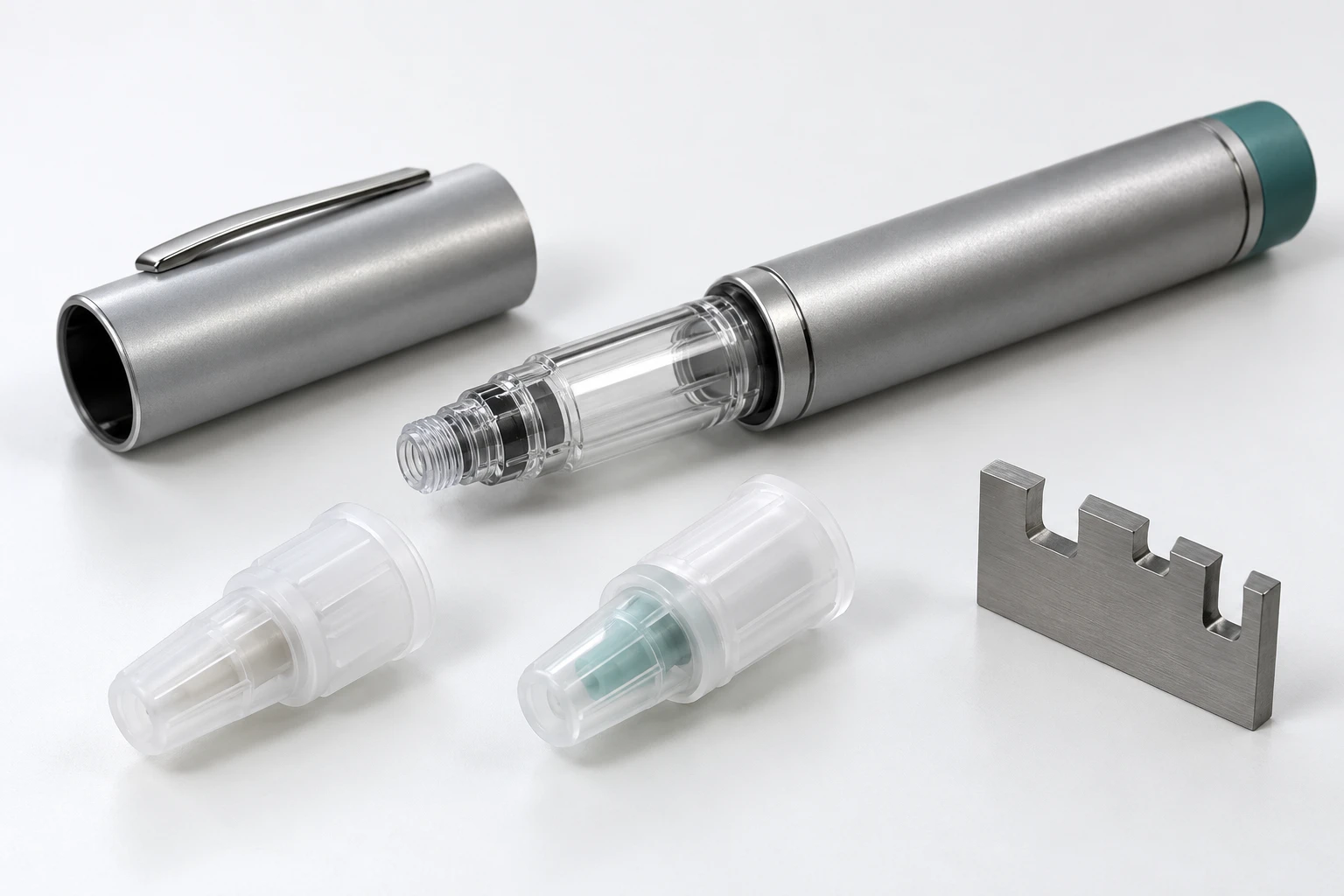
Start with the needle type and the standard scope
Define whether the proposed product uses a detachable double-ended pen needle, an integrated needle or another fluid path. ISO 11608-2:2022 covers single-use sterile double-ended pen needles for specified needle-based systems with non-integrated needles; its scope is not a general approval of every needle that resembles a pen accessory. The public introduction also explains why the earlier Type A interchangeability designation was removed. A familiar attachment format therefore needs configuration-specific evidence. Ask the supplier to name the pen and needle references covered by its report, including the cartridge arrangement. Keep the standard edition and the product revision beside the evidence reference. If the planned design falls outside the published scope, the development team should document the applicable evaluation route. Procurement staff should not extend a detachable-needle report to an integrated-needle autoinjector simply because both products appear in the same catalogue.
Identify the complete combination
- Pen model, cartridge holder and relevant drawing revisions
- Needle manufacturer, product reference and controlled specification
- Cartridge or container reference and closure arrangement
- Applicable needle category and intended attachment interface
Source references: ISO 11608-2:2022: Double-ended pen needles, public scope, ISO 11608-2:2022: Public introduction and foreword.
Review the interface drawing beyond its nominal thread
A statement that the threads match leaves several dimensional relationships unresolved. Ask for the controlled interface drawing and identify which surfaces locate the needle hub relative to the holder and cartridge closure. The development team should determine the tolerances relevant to seating, alignment and the intended fluid path. A physical sample can help an engineer understand an interface, but it does not replace a drawing or a tolerance assessment. Keep supplier-specific details confidential under the agreed document arrangements; a redacted evidence summary may be a practical first step in a quotation discussion. Record which characteristics were actually checked and which remain assumptions. If a proposed supplier uses the same commercial description for several hub designs, ask whether the description maps to one controlled component reference. This makes later substitutions easier to detect and stops a nominal size from becoming an unsupported universal-compatibility claim.
Interface review record
- Reference surfaces and seating arrangement
- Attachment geometry, tolerances and drawing ownership
- Needle-to-container alignment considerations
- Holder, hub and closure revision cross-reference
- Open dimensional questions requiring engineering resolution
Ask for functional evidence on the assembled system
A successful attachment check answers whether the parts can be joined under the conditions examined. Delivery evidence addresses a different question: whether the intended system performs its specified function with those parts. Request a report that identifies the tested configuration and the relevant endpoints. ISO's public revision summary for Part 2 identifies delivered-dose and hub-removal assessments among the compatibility changes; the approved protocol still needs the applicable requirements and methods from the controlled standard. Avoid substituting a general needle certificate for that configuration record. The sponsor should also determine how the chosen needle relates to the product's intended use and instructions. Document any relevant conditioning, lot selection and component variation in the test plan. A manufacturer statement covering one pen family should identify the basis for including each variant rather than relying on a shared external appearance or a similar product name.
Evidence to request from the responsible teams
- Tested pen, needle and container identifiers with lot traceability
- Applicable attachment, removal and delivery endpoints
- Protocol, conditions, acceptance criteria and deviations
- Rationale for including untested variants in a defined family
Source references: ISO 11608-2:2022: Public introduction and foreword.
Control the approved combination through purchasing and labeling
Give the compatibility record a place in the purchasing specification so it remains connected to what is ordered. An approved needle reference should not be replaced solely because another item has the same gauge or attachment description. Require a change notice with the proposed component reference and the reason for the substitution. The developer can then assess the effect on interface evidence, delivery requirements and labeling. A private-label programme also needs agreement on who authorizes compatibility wording on cartons and instructions. Device manufacturers and the medicinal-product applicant may have different responsibilities, which should be recorded before artwork approval. ISO 13485 is a medical-device quality-management reference, not proof that a particular combination has passed. Ask for the configuration-specific evidence behind a claim and a defined approval path for changes. This article concerns OEM development and purchasing; patients should follow their prescribed product instructions rather than select or substitute needles from a procurement checklist.
Change-notice questions
- Which approved component or drawing will change?
- Which compatibility evidence and risk controls are affected?
- Who decides whether further evaluation is necessary?
- Which labeling and purchasing records need a revision?
Source references: ISO 13485:2016: Medical device quality management systems.
Frequently asked questions
Does a pen needle fit if it can be screwed onto the holder?
That demonstrates an attachment observation for the parts examined. It does not establish the required delivery performance or all applicable compatibility endpoints. Request evidence that identifies the complete pen, needle and container combination.
Is ISO 11608-2 a universal pen needle compatibility certificate?
No. It is a standard for a defined needle category. The supplier should identify the tested configuration and the applicable requirements. A statement naming the standard without the component references cannot establish compatibility for every pen.
Can two needles with the same gauge be treated as equivalent?
Gauge alone does not identify the complete needle assembly or its interface. Compare the controlled component specifications and assess the proposed substitution against the approved configuration and existing evidence.
Can an OEM buyer authorize a needle substitution without the product applicant?
The development and quality agreements should identify the approval responsibilities. Changes that affect the intended combination, its evidence or its labeling require review by the responsible teams before use. This is not a patient-use substitution guide.
References and editorial scope
- ISO 11608-2:2022: Double-ended pen needles, public scope
- ISO 11608-2:2022: Public introduction and foreword
- ISO 13485:2016: Medical device quality management systems
Prepared by Hytanbio Tech for OEM procurement and development discussions. Sources checked October 31, 2026. Public standard descriptions identify scope; the responsible teams need controlled standards and product-specific protocols for formal evaluation. The checklists are editorial recommendations, not quoted standard clauses, patient instructions, regulatory advice or Hytanbio test results. No certification or product authorization is asserted. Recheck draft guidance and standard editions before relying on them for a project.